
"We are marrying because we love each other" sounds obvious, yet for most of history it was an unusual thought. The American historian Stephanie Coontz, who has studied the history of marriage, explains that for a very long time marriage was a matter of family and livelihood more than of love. Following that history shows which parts of a wedding are old and which are new.
For a long time, marriage was family business
The Irish Times article How marriage came to be about love rather than strategy presents Coontz's research: for centuries marriage was a way to extend kinship and pass on property and labour. Who married whom was decided by families more than by the couple. Love existed, but it was not the condition for marrying.
The parents entering first, the two mothers lighting candles, the bride walking in on her father's arm: these are traces of that period. A wedding was the occasion on which two families formed a bond in front of their guests.
The eighteenth century: love becomes the condition
According to the same article, the change began with the Enlightenment. As ideas about individual choice and happiness spread, the "love match", in which people chose their own partner and gave affection as the reason, became the ideal. At the time there were also worries that this would make marriage less stable.
In the period that followed, a model spread in which husband and wife formed a pair by taking different roles. The article notes that this model was treated as the standard for only about a hundred years. Much of what we call "traditional marriage" is not very old.
What changed in the ceremony: vows and the couple's own moments
Once love became the reason for marriage, the ceremony changed too. Next to the moments that belong to the family, moments appeared in which the two people speak for themselves.
- Vows: from repeating set phrases to reading words the couple wrote.
- The ring exchange and first kiss: a promise between two people, not between two families.
- The first dance and toasts: time for guests to hear the couple's story and celebrate with them.
In The Knot's 2026 Real Weddings Study, 61% of US couples said they wrote their own vows, which belongs to the same current.
Today's ceremony: family moments and the couple's moments together
A wedding today has two layers. The order from the age of families (the parents' entrance, the bow to the parents) and the order from the age of the couple (vows, letters, a dance) sit in the same programme. Neither is the correct one. The measure is the balance that the couple and both families are comfortable with.
- Put the moments the older generation expects into the first part of the ceremony.
- Adding even one moment in which the couple speaks in their own words changes the feel of the day.
- Leave generous time for the reception, where you are with your guests.
What to check when applying this in Korea
| What to check | Why it matters |
|---|---|
| Whether the couple can set the running order | Adding or removing vows, letters or a dance needs room to adjust |
| Whether the time slot is generous (three hours or more) | Both the family moments and the couple's moments fit |
| Whether the MC accepts a custom script | Personal vows and toasts flow naturally |
| Whether the microphones suit spoken vows | Words read quietly must reach the back row |
| Whether both sets of parents have been consulted | If a customary moment is dropped, explain it beforehand |
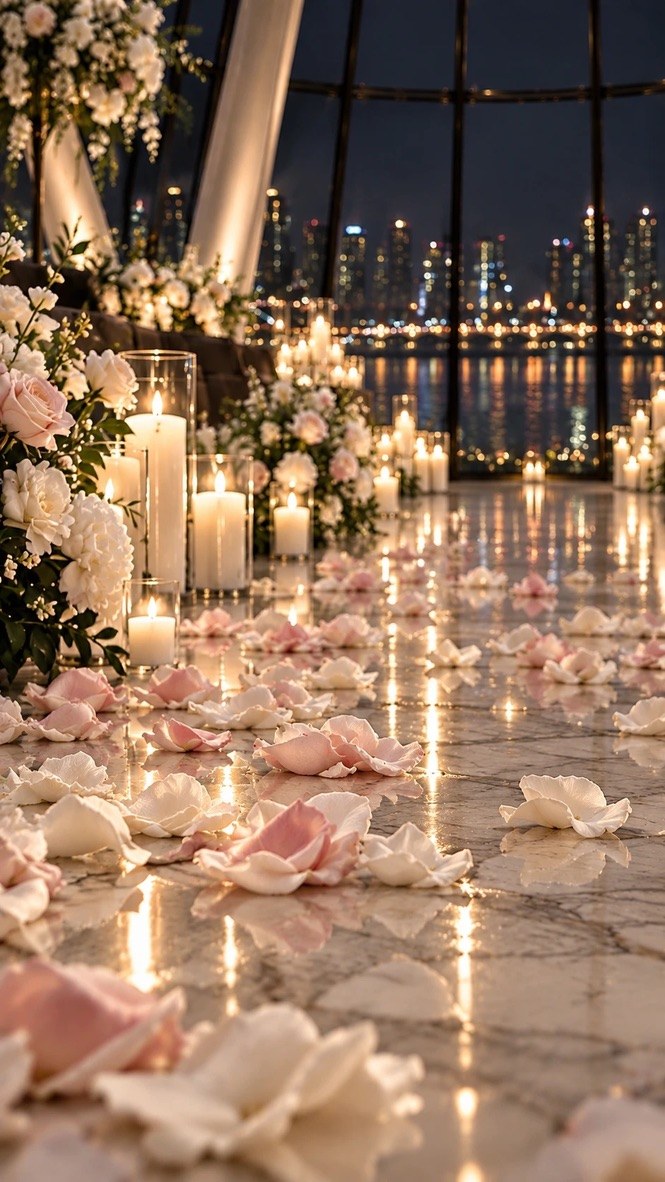
At a venue with a generous time slot, such as one on the Han River in Seoul, the parents' entrance, personal vows and reception toasts can be joined into one flow.
Summary
- Marriage was long a matter of family and livelihood. Love became its condition from the eighteenth century onwards.
- The parents' entrance and the bow to parents come from the age of families. Vows and letters come from the age of the couple.
- Planning a ceremony today means deciding the balance between the two.