
"We want no officiant's address — what do we put in instead?" is the question we hear most these days. Overseas, the non-religious ceremony is already the norm and its skeleton is well established. Using the ceremony guides from The Knot and Joy in the US, we built three running orders, timed to the minute, for three situations. Use them as they are or change only the marked parts.
The skeleton of a ceremony overseas
According to Joy's guide to the ceremony order, a non-religious ceremony usually lasts 20–30 minutes and runs: processional → welcome (2–3 min) → readings (optional, 2–5 min each) → the officiant's remarks (3–7 min) → vows (3–8 min, 1–2 min each) → rings (2–3 min) → unity ceremony (optional, 3–5 min) → pronouncement (30 seconds) → kiss → recessional (2–3 min).
The Knot's secular ceremony guide recommends placing readings and the unity ritual straight after the welcome, and also presents a story-led structure: the couple's story → thoughts on marriage → vows → rings → pronouncement. The biggest difference from a Korean wedding is that there is no officiant's address; the couple's own vows take its place.
Order 1 — A Korean-style ceremony without an officiant's address (35 minutes)
Both sets of parents are Korean, and a single MC leads in place of an officiant.
| Time | Item | Notes |
|---|---|---|
| 0:00 | Opening, parents' entrance | The mothers' candle lighting goes here if you want it |
| 0:04 | Groom's entrance → bride's entrance | With her father, or with both sets of parents |
| 0:08 | Welcome (MC, 2 min) | Introduces the couple to the guests |
| 0:10 | The couple's story (MC or a friend, 3 min) | In place of the address: how they met, what each admires in the other |
| 0:13 | Vows (1–2 min each, self-written) | Read them. Do not memorise |
| 0:17 | Exchange of rings | The MC says a word on their meaning |
| 0:19 | Declaration of marriage, kiss | |
| 0:20 | Greeting both sets of parents | A deep bow or an embrace — the family decides |
| 0:24 | A song or one speech (4 min) | Both together push past 35 minutes |
| 0:28 | Recessional | Petals, bubbles and so on |
| 0:30 | Group photographs | Family, then friends |
You may change: candle lighting, the song, the bouquet toss. Better left as they are: the vows and the greeting to the parents. These two fill the place of the address.
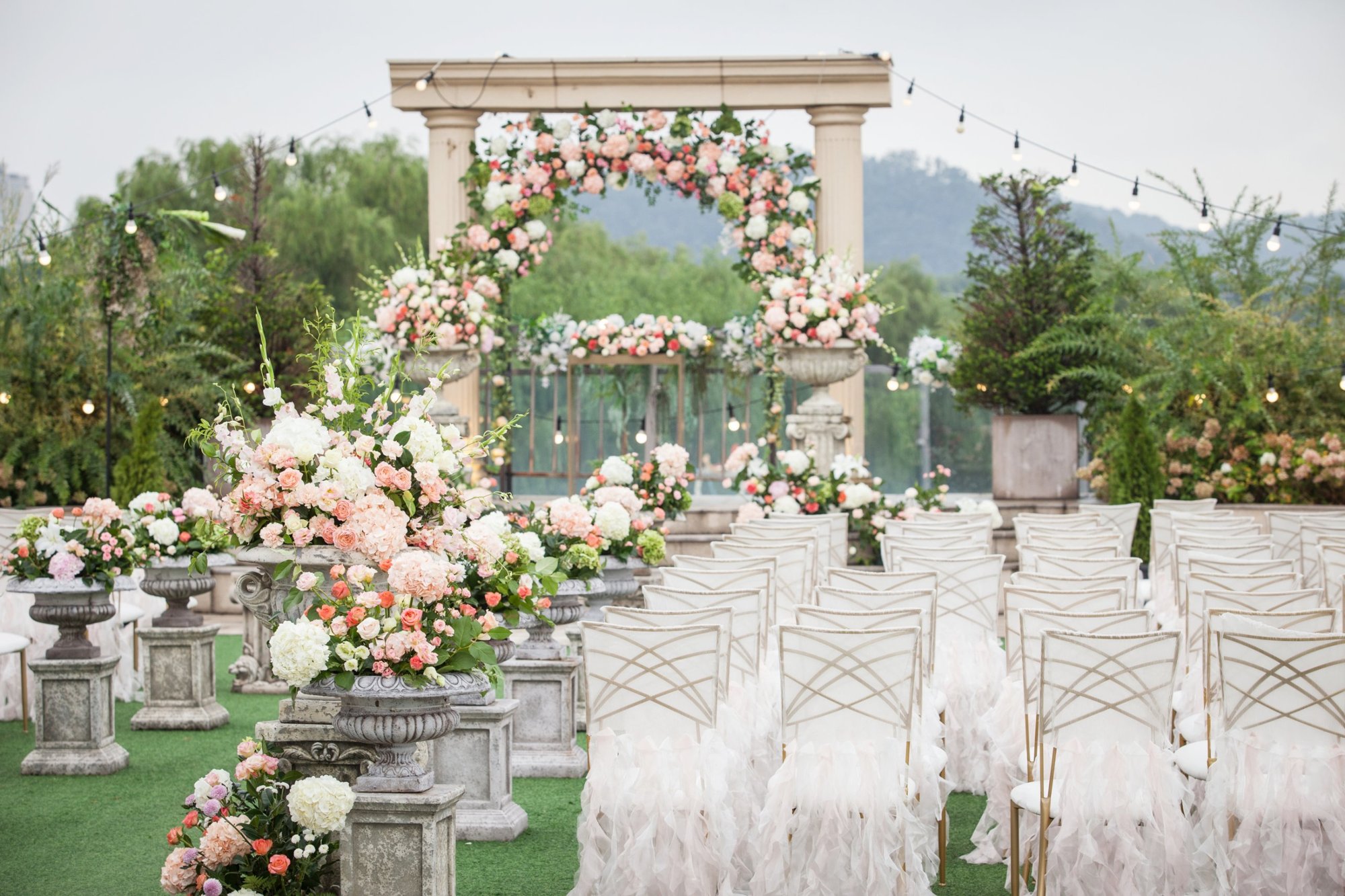
Order 2 — A ceremony for families from two countries (40 minutes)
One family expects Korean formality, the other a Western, vow-centred ceremony. The principle: each side's ritual once, languages in turn.
| Time | Item | Language |
|---|---|---|
| 0:00 | Opening, parents' entrance | Korean and English, briefly |
| 0:04 | Couple's entrance | — |
| 0:08 | Welcome (2 min) | The MC, one minute in each language |
| 0:10 | Reading 1 — bride's family or friend (3 min) | The reader's language |
| 0:13 | Reading 2 — groom's family or friend (3 min) | The reader's language |
| 0:16 | Vows (2 min each) | Each in their mother tongue, plus one sentence in the other's |
| 0:20 | Exchange of rings | The MC in both languages |
| 0:22 | Unity ritual (4 min) | Sand ceremony, candle or handfasting |
| 0:26 | Declaration of marriage, kiss | Once in each language |
| 0:27 | Greeting both sets of parents | A deep bow on the Korean side, an embrace on the other — each in their own way |
| 0:31 | A song or speech (4 min) | |
| 0:35 | Recessional |
The language rule: announcements briefly in both languages; the emotional passages (vows, readings) only in the speaker's language, with translation in the programme or on screen. Say everything twice and the ceremony doubles in length while guests stop listening to half of it.
Order 3 — A short ceremony and a long reception (20 minutes + 2 hours 30)
The overseas structure: only the essentials in the ceremony, everything else in the party. It suits 100 guests or fewer and a slot of three hours or more.
Ceremony (20 min): processional (4) → welcome (2) → vows (4) → rings (2) → declaration and kiss (1) → greeting the parents (3) → recessional (2). Readings, songs and the unity ritual all move to the reception.
Reception (2 h 30): cocktail hour (30 min, with photographs) → entrance and first dance (10) → dinner (60) → two or three toasts (15, under three minutes each) → cake cutting and bouquet toss (10) → after-party (45 or more).
This structure assumes the ceremony and reception can run back to back in the same space and that the couple sets the order. Where weddings are scheduled close together, check whether time for a reception can be secured.
Order 4 — A real two-part Korean wedding (October 2023, Sevit Island)
If the three above are blueprints, this is a running order actually used at a wedding venue on the Han River in Seoul. The couple's names are withheld. An MC led without an officiant, and a part-two reception followed the part-one ceremony in the same hall — a form between Orders 1 and 3.
| Part | Item | Details |
|---|---|---|
| Before | Rehearsal | Couple's rehearsal, meeting with the MC |
| Before | Reception | Greeting guests |
| Part 1 | Settling the room | The MC asks guests to be seated |
| Part 1 | Opening declaration | |
| Part 1 | Couple enters together | Instead of the bride entering with her father |
| Part 1 | Bow to each other | The couple face each other and bow |
| Part 1 | Marriage vows | Read aloud by the couple |
| Part 1 | Exchange of gifts | |
| Part 1 | Declaration of marriage | By the MC |
| Part 1 | Congratulatory speech | |
| Part 1 | Thanks | Bride's parents → groom's parents → guests |
| Part 1 | Recessional, closing | |
| Photos | Photographs | Family and relatives → friends |
| Part 2 | Settling the room | Announcement that part two begins |
| Part 2 | Re-entrance | The couple |
| Part 2 | Cake cutting | |
| Part 2 | Toast | The couple |
| Part 2 | Table greetings | The couple visit each table |
| End | Settlement |
Three things to notice. Entering together (the overseas choice of walking side by side rather than the bride being "given away"), vows read aloud by the couple (the heart of what replaces the address), and the order of thanks (bride's parents → groom's parents → guests). The re-entrance, cake, toast and table greetings of part two compress the reception of Order 3 into a Korean form.
The declaration of marriage the MC read at this wedding was as follows. Without an officiant, the MC reads the declaration and the couple sign it, which keeps the weight of the word "declare".
Declaration of Marriage
With the blessing of all of you here, the groom ○○○ and the bride ○○○ have, in the presence of their families, relatives and friends, firmly vowed to be husband and wife and to share joy and hardship throughout their lives. I now solemnly declare before you that the two are married.
○○ / ○○ / 20○○ — Signature ________
For an international couple, rather than reading the same sentence again in English, it is more natural to print the declaration in two languages and have both sign it.
Choosing a unity ritual
A symbolic act of becoming one that fits any of the three orders. Joy lists candle lighting, the sand ceremony, sharing wine, planting a tree and handfasting.
- Sand ceremony: two colours of sand poured into one vessel. If both sets of parents pour first and the couple last, it comes to mean two families. It suits international couples best.
- Unity candle: the couple light a large candle from candles lit by their mothers. It follows naturally from the Korean candle lighting.
- Handfasting: the Celtic tradition of binding the hands with ribbon — the origin of "tying the knot".
What to check when applying this in Korea
| What to check | Why it matters |
|---|---|
| Can the couple set the running order? | All three orders need a venue that allows it |
| Can the MC work in two languages? | The premise of Order 2 |
| Is a ceremony of 35–40 minutes allowed? | With less time, Orders 1 and 2 have to be shortened |
| Can a table and props for the unity ritual be brought in? | Check the rules on wind and flame for sand and candles |
| Does the reception follow in the same space? | The premise of Order 3; three hours or more |
For example, the Convention Hall at Sevit Island on the Han River in Seoul offers bilingual English–Korean MCing and, within a generous time slot of three hours or more, runs ceremony and reception in the same hall. When choosing a venue, show one of the tables above and ask "may we change the order like this?" — the answer comes at once.