
In the work of five florists featured by the overseas wedding press since 2025 and five designers long active on the world stage, what carries over to a wedding in Korea is less a list of flowers than a way of reading the place and designing form. (As of November 2026)
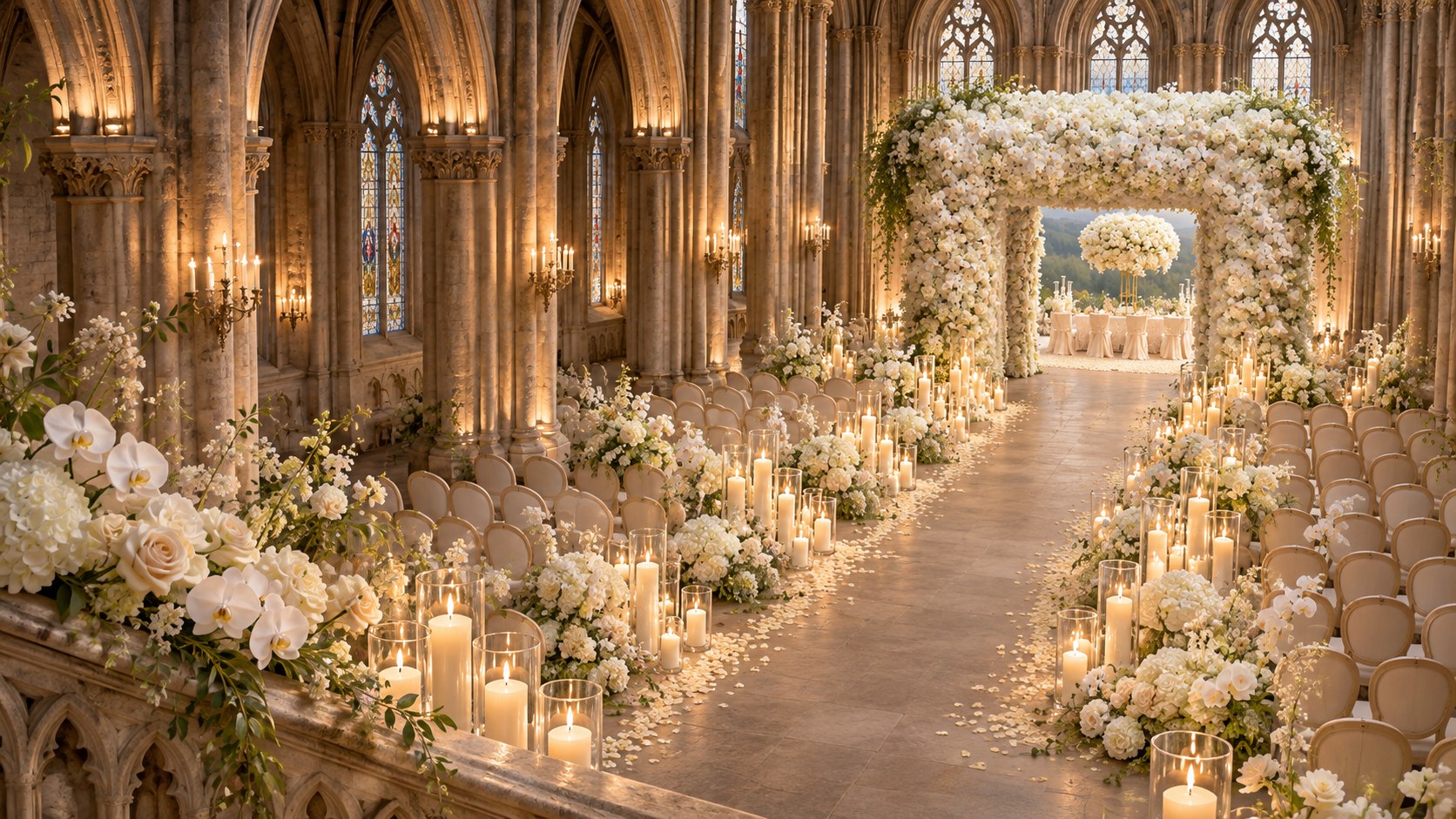
1. Gabriela Salazar: a scene that seems to have grown there
At a Blackberry Farm wedding featured in Vogue, Gabriela Salazar used the vegetation and moss of the surrounding hills so that the aisle flowers looked as if they had grown on the spot. Repeating the pink and orange of the sunset in flowers and fabric was central too. Her work is at @lamusadelasflores.
In Korea, rather than gathering wild flowers, first check the site manager's permission and what is in season locally. Set out low drifts of flowers and hide the base of structures with moss or leaves, and it looks like a garden that was always there without using many flowers.
2. Ren MacDonald-Balasia: locality and painterly scale
At a wedding in Hawaii featured in Vogue, Ren MacDonald-Balasia drew on local materials and traditional techniques and composed orchids and alliums as if they had sprung up naturally. At a wedding in Los Angeles she bound lavish, oil-painting-like flowers, vivid colour and a butterfly motif into one landscape. Her account is @renkofloral.
To recreate this, build on local seasonal branches and foliage and use rare imported flowers only at the focal point for photographs. A couple's symbol sits more naturally woven into colour and repeated pattern than attached as a separate decoration.
3. Rachel Cho: asymmetry and the power of one variety
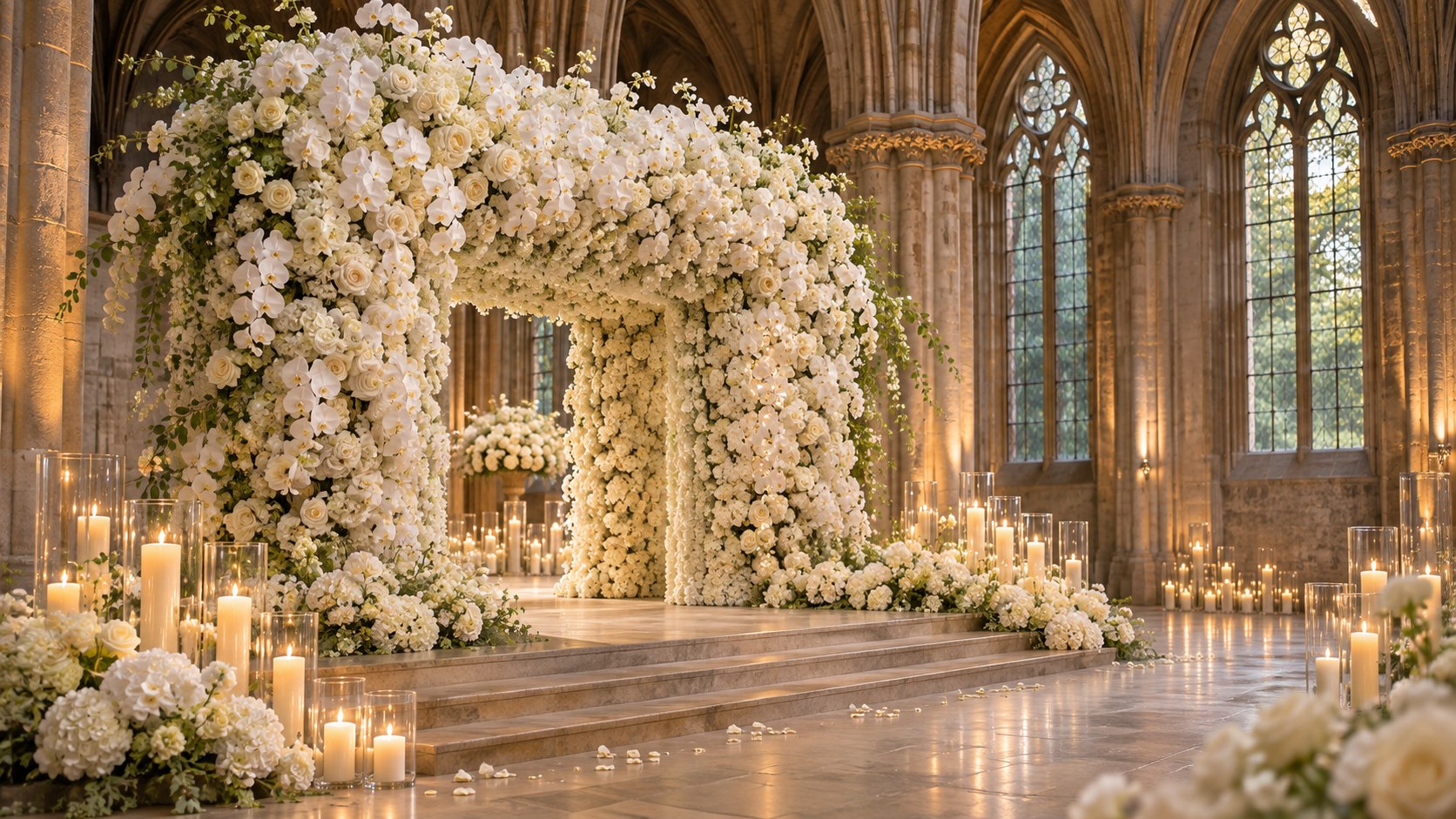
In Brides' 2025 flower trends, Rachel Cho explains that an asymmetrical arch creates movement and air, and that even a single variety makes a strong scene when arranged loosely and organically. Her account is @rachelchofloral.
In Korea, choose one flower available in steady quantity that season and vary its height and direction. A frame weighted to one side or open in its curve, rather than a perfect circle, brings the silhouette alive without adding varieties.
4. Maddi Haley: living sculpture
In its 2025 Ones to Watch, The Knot introduces Maddi Haley's Absūna as "living sculpture" that starts from irregular growth and movement, and notes her preference for reusable structures and locally grown flowers over floral foam.
Absūna is a design studio in Providence, Rhode Island. According to the studio, it offers abstract floristry and creative direction for weddings, events, editorial and commercial projects across the Northeast and at destination events, taking nature as its guide, working with the seasons and aiming for "design that evokes curiosity."
- Website: absuna.com
- Instagram: @absuna__
Instead of a mood board listing flower names, set a vocabulary of form: a line flowing to the left, deliberate empty space, irregular heights. At the quotation stage, ask about seasonal flowers from Korean growers, reusable frames and whether floral foam is used.
5. Naomi Azriel: a still life made from feeling
The same article in The Knot explains that Naomi Azriel's Nectar & Vessel begins a design from the feeling the couple wants and composes flowers and produce like a Dutch still life. Small variations from table to table and sourcing most materials from local farms and women-owned businesses are also characteristic. Her account is @nectarandvessel.
In Korea, choose one word first — abundance, calm or festivity — then mix flowers and fruit of the same season low on the table. Keep the colour consistent but vary the vessels and heights a little from table to table, and it feels less like duplicated decoration and more like walking through an exhibition.
6. Karen Tran: walls and ceilings built from flowers
Karen Tran is a floral designer based in San Diego who has designed weddings and events for more than twenty years. According to Thursd, roses and phalaenopsis orchids used in quantity are her mainstays, joined by hydrangeas, callas and dahlias in mostly pastel tones. Bridestory points to walls of flowers, blooms hanging from the ceiling and layered arrangements cascading from tables, and also introduces the master floral classes she teaches around the world. Her work can be seen at karentran.com and @karentranevents.
In the same article she advises gathering the flowers at one focal point when the budget is limited. In Korea, too, rather than covering the whole hall thinly, concentrate the quantity on the wall behind the stage or at the entrance, and use costly flowers such as phalaenopsis only at eye level.
7. Jeff Leatham: simple form, bold colour
Jeff Leatham is the floral artist known as artistic director of the Four Seasons Hotel George V in Paris. Thursd describes his work as using shape, colour and simplicity to make bold statements that become part of the setting, and notes that his installations are often likened to contemporary art. His work can be seen at jeffleathamflowers.com and @jeffleatham.
The key to recreating it is to reduce the number of varieties. Choose one colour and one or two varieties and repeat them in identical vessels: supply and quotation become simpler than with a mix, and a long space such as a lobby or an aisle gains rhythm.
8. Preston Bailey: turning a room into a stage
Preston Bailey is an event designer who opened his studio in New York in 1980. Thursd describes him as known for turning ordinary spaces into lush, theatrical environments, and mentions his books, including Designing With Flowers, and his masterclasses for younger designers. His work can be seen at prestonbailey.com and @prestonrbailey.
This approach is not completed by flowers alone. Lighting, fabric and structures have to move together, so in Korea the first step is for the florist and the venue's production team to look at the same floor plan from the outset and agree on ceiling loads and installation time.
9. Philippa Craddock: seasonal flowers from nearby
Philippa Craddock is a self-taught designer who became one of London's leading event florists, and she created the flowers for the wedding of Prince Harry and Meghan Markle at St George's Chapel, Windsor, in 2018. Gardenista reported the plan to use seasonal flowers such as peonies, foxgloves and white garden roses with branches of beech and birch from Windsor Great Park, and her statement that sustainability was at the forefront. Her work can be seen at philippacraddock.com and @philippacraddock.
In Korea, ask first which flowers Korean growers have in the month of the wedding, and build volume with seasonal branches and foliage. The smaller the share of imported flowers, the fewer the variables from weather and logistics.
10. Kiana Underwood: many varieties within one colour
Kiana Underwood leads Tulipina, a floral studio in San Francisco. Thursd describes her signature as unusual colour combinations and a wide range of varieties, especially arrangements built in a single colour. Her book Color Me Floral covers monochromatic arrangements for each season. Her work can be seen at tulipina.com and @tulipinadesign.
A single-colour scheme has the advantage of easy substitution. Once the colour is fixed, a variety that fails to arrive in the wedding week can be replaced by another flower of the same colour, which makes it sensible to agree on colour and tone rather than variety at the contract stage.
What to check when applying this in Korea
| Item | Guideline |
|---|---|
| Seasonal supply | Build on seasonal Korean flowers rather than rare imports, and agree substitutes |
| Structure and safety | Check the load of arches and ceiling pieces, evacuation routes and the rules on candles |
| Sustainability | Ask about floral foam, reusable frames and where the flowers go afterwards |
| Proportion | Do not rely on photographs; scale to the aisle width and ceiling height |
| Time | In a large space such as Sevit Island, plan installation, changeover and removal separately from the running order |
Summary
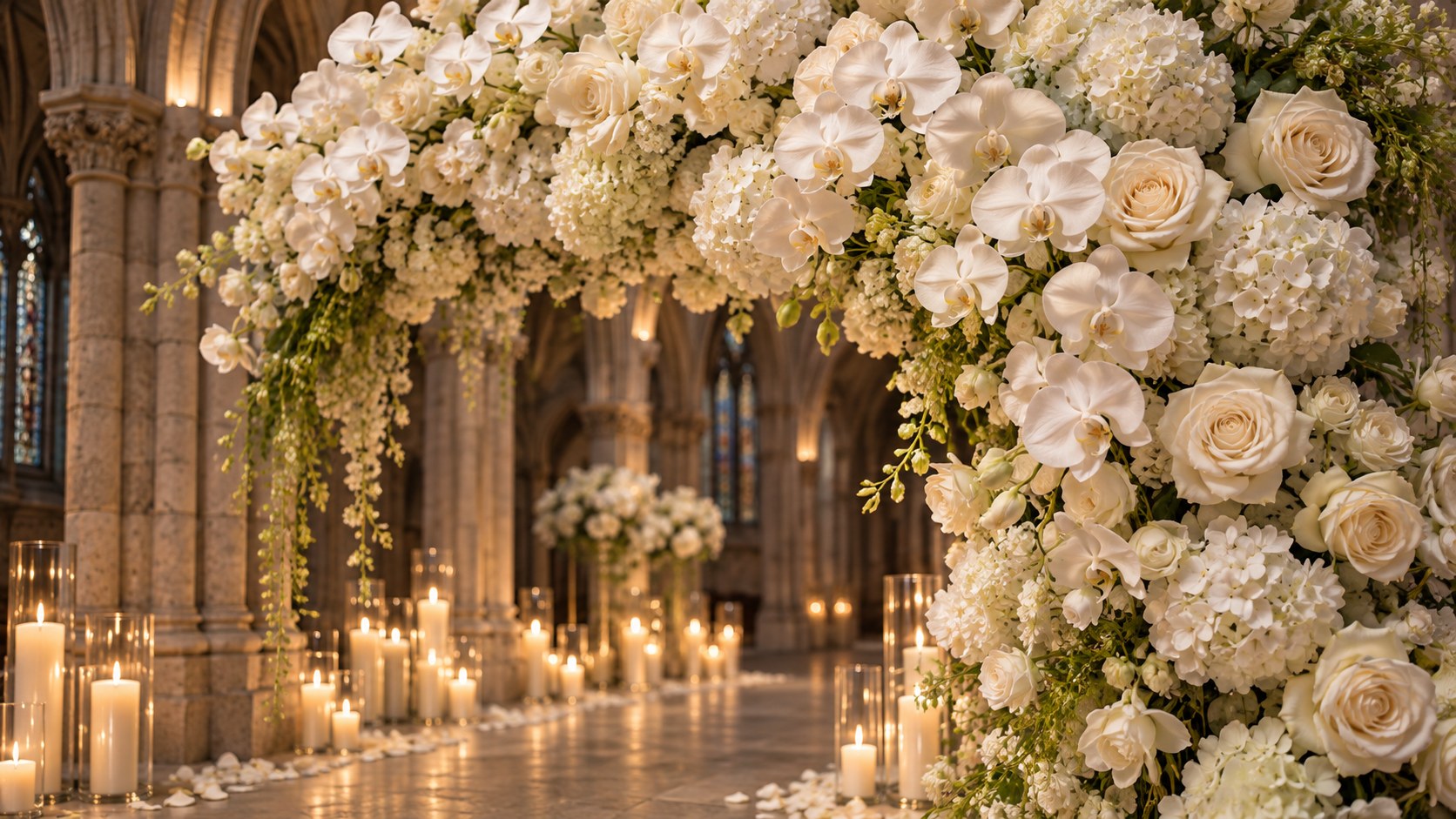
What the ten have in common is not using many expensive flowers. They read the colours and vegetation of the place, settle on one principle of form and adjust the scale with seasonal materials. When recreating their work in Korea, rather than copying a piece, hold clearly to one principle: ground-level drifts, asymmetrical line, a single variety, reusable structure, still-life tables, flowers gathered at one focal point or a single-colour scheme.
Sources
- Vogue, The Bride Wore a Dramatic Taffeta Train to Marry Among the Magnolia Trees at Blackberry Farm
- Vogue, The Bride Wore Custom Schiaparelli for Her Elegant Beach Wedding on Hawaii’s Big Island
- Vogue, The Brides Hosted a Whimsical Los Angeles Wedding Filled With Butterflies and Chartreuse Details
- Brides, 6 Wedding Flower Trends Florists Are Pushing for in 2025
- The Knot, Top Emerging Wedding Pros: The Knot Ones to Watch 2025
- Thursd, Karen Tran
- Bridestory, Karen Tran's Flower Power
- Thursd, Jeff Leatham
- Thursd, Preston Bailey
- Gardenista, Royal Wedding florist Philippa Craddock
- Thursd, Tulipina
- Absūna, About