
After the dress, nothing shapes the look of a bride as much as the veil. Yet the veil did not begin as decoration. It was a cloth to cover the bride, to protect her, and sometimes to check who she was. Here is where the veil came from, the meanings it passed through, and the types there are today. The story of the tiara is in The Tiara: From a King's Headdress to the Bride's, and this year's direction is in Veil, Tiara and Wedding Shoes: The 2026 Trends.
Antiquity: a cloth to cover and protect the bride
The List's history of the bridal veil traces the veil to ancient Greece. According to wedding historian Susan Waggoner, veils then wrapped the bride from head to toe and stood for the delivery of a modest bride. When marriage was an exchange of property and status, the veil also kept the groom from seeing the bride's face before the ceremony.
The other reason was belief. The veil was thought to hide the bride from evil spirits who might envy her happiness. Bridesmaids are said to have dressed like the bride for the same reason.
Brides in ancient Rome wore a veil called the flammeum. Wikipedia's entry on the veil describes it as a deep yellow, like a candle flame. In WeddingWire's guide to the veil, fashion historian Cornelia Powell says this saffron colour symbolised the flame of Vesta, goddess of hearth and home. The bride's colour was then not white but the colour of fire.
The veil in religion: a cloth for checking and for vows
In the weddings of different faiths the veil took on meanings of its own.
- The Jewish bedeken: before the ceremony the groom himself places the veil over the bride's face. The custom recalls the Biblical story of Jacob, who married the veiled Leah believing her to be Rachel, and so the groom confirms that this is his bride. Wikipedia also cites the scene in Genesis in which Rebekah covers herself with a veil as Isaac approaches.
- Christianity: in the 1600s, as weddings took on a more religious character, the veil became a symbol of purity. A white veil stood for chastity, and lifting it came to signify the couple's access to one another.
- The Indian dupatta: WeddingWire also lists the long, ornate dupatta that covers the head and shoulders as a bridal veil.
One piece of cloth meant protection, confirmation or a vow, depending on the culture.
Gone and back again: Queen Victoria, 1840
The veil was not always in fashion. According to Wikipedia, bridal veils were generally out of favour in Britain and North America in the seventeenth and eighteenth centuries. Powell also notes that face-covering veils were not allowed at royal weddings: most royal marriages were arranged, and there was a fear that someone else might be standing behind the veil.
What brought the veil back was the wedding of Queen Victoria and Prince Albert in 1840. The Queen wore a white dress with a veil flowing down her back, and brides around the world followed. In the Victorian era the veil was also a sign of rank, its weight, length and quality showing a family's standing. Veils covering the face became common again only in the second half of the nineteenth century.
The veil today: from meaning to taste
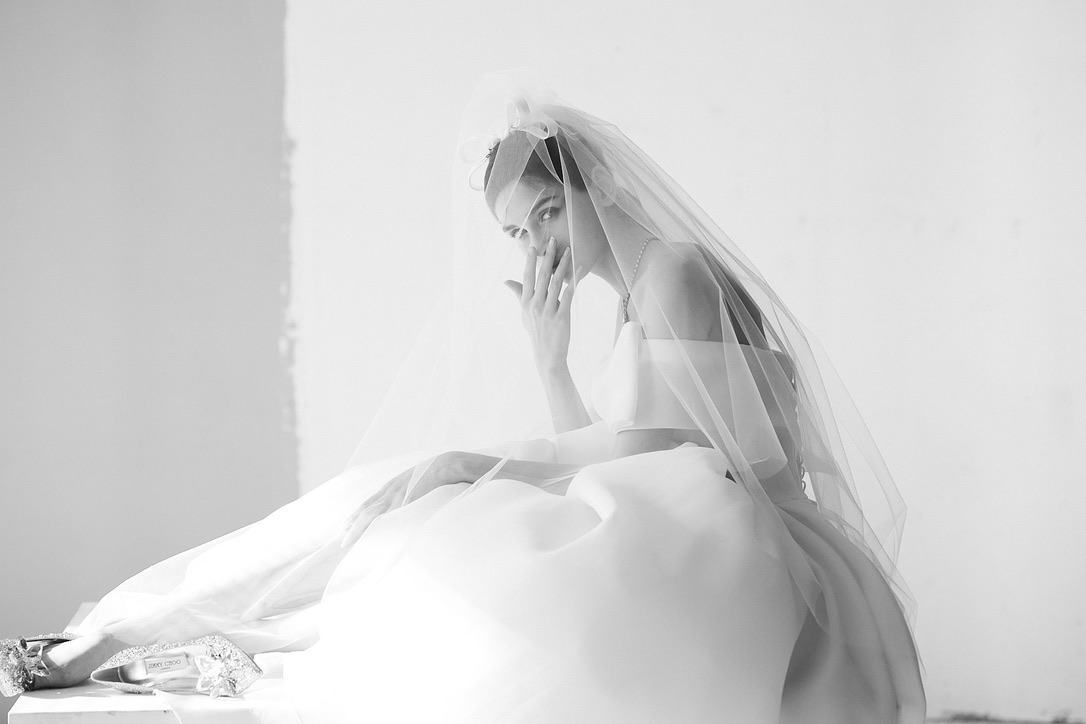
A bride today wears a veil because she wants to, not because she must. The List reports that most brides now skip the face covering and wear the veil at the back of the head, while many choose a flower crown or a tiara, or no veil at all. Meghan Markle's veil in 2018 was 16 feet long, and embroidering the flowers of the 53 Commonwealth countries by hand took hundreds of hours. The cloth that once concealed now tells a story.
Who lifts the veil is not fixed either. WeddingWire gives three options.
- The bride's father lifts it after the processional.
- The bride keeps the blusher on through the ceremony and the groom lifts it before the first kiss.
- The bride lifts it herself.
Types of veil
Veils are named by their length and the way they are worn. Knowing the names below makes it easier to describe what you want at a fitting.
| Type | Length and form | Works for |
|---|---|---|
| Birdcage | A short net veil covering about half the face | Short dresses, small weddings, the after-party |
| Blusher | A short single layer worn over the face and lifted during the ceremony | A classic entrance, sometimes layered with a long veil |
| Shoulder and elbow | From the shoulder to the elbow | When you want the waistline and back detail to show |
| Fingertip | To the fingertips | The most versatile length, easy to manage indoors and out |
| Chapel | Just brushing the floor | Halls with an aisle, dresses with a short train |
| Cathedral | The longest, trailing beyond the hem | Large halls with a high ceiling and a long aisle |
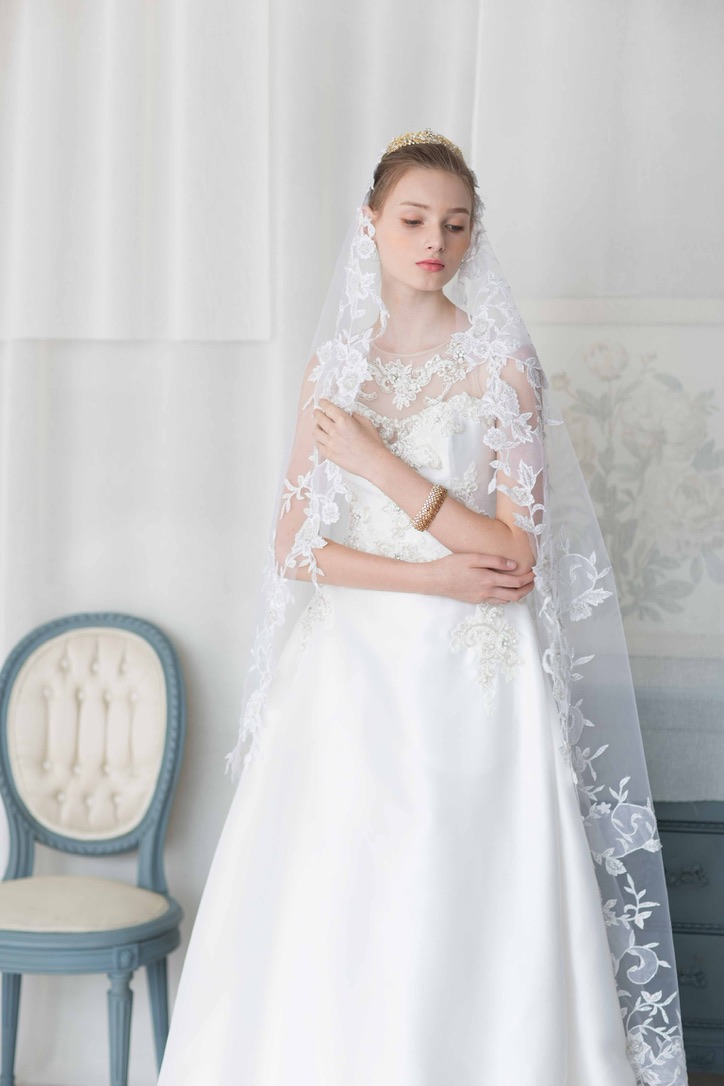
| Mantilla | A single rounded piece edged with lace, laid over the head | Plain satin gowns, a classic mood |
| Juliet cap | Fitted over the head like a cap and falling behind | Vintage dresses, updos |
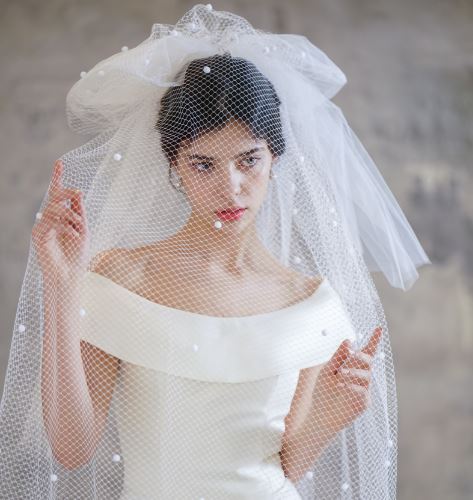
| Bubble or pouf veil | Several layers of tulle gathered for volume | Editorial photographs, dresses with a simple silhouette |
There are three things to weigh.
- Balance with the dress: with a heavily decorated dress, choose plain tulle. With a simple dress, add interest with lace, pearls or a bow on the veil.
- Venue and floor: a long veil is at its best in a wide indoor hall. Outdoors on grass and decking a trailing length catches easily, so fingertip or chapel is easier to manage, and on a windy rooftop use plenty of pins.
- Running order: many brides wear a long veil for the ceremony and remove it, or change to a short one, for the reception and after-party. Ask for it to be pinned where it is easy to take off.
What to check when applying this in Korea
| What to check | Why it matters |
|---|---|
| Length and width of the aisle | Whether it can take a chapel or cathedral veil |
| Floor surface (grass, decking, carpet) | Whether a trailing veil will catch or get dirty |
| Wind (outdoors, by the river, on a rooftop) | Decide in advance how a long veil is secured |
| Whether the dress shop can fit the veil with the dress | Chosen separately, the tones of white clash |
| Who lifts the blusher, and when | Put it in the programme and agree it with the MC and photographer |
| When and where the veil comes off before the reception | A generous time slot leaves room to redo the hair |
One wedding venue on the Han River in Seoul, for example, has both a large hall with a 13-metre ceiling and an outdoor garden, so the veil length that suits the same bride differs by space. Taking photographs of the aisle and the floor to your dress fitting speeds things up.
Summary
- The veil began in ancient Greece and Rome as a cloth to cover and protect the bride. The Roman flammeum was a flame-like yellow.
- Faiths added meanings of confirmation and vow, as in the Jewish bedeken.
- After a period out of fashion, the veil returned with Queen Victoria's wedding in 1840.
- Today it is a matter of taste. Choose length and form for the dress, the venue and the running order.
Sources
- The List, Inside the History of the Bridal Veil
- WeddingWire, The Wedding Veil, Unveiled
- Wikipedia, Veil