
At a wedding the cake is a scene before it is a dessert. The moment when two people hold one knife and cut the first slice appears in almost every wedding album. But why a cake, why white, and why in tiers? Here is how the wedding cake came to look the way it does, where its design is heading in 2026, and what to check when you choose one. The story of the white dress is told separately in Why Wedding Dresses Are White.
The beginning: a kiss over a pile of buns
Wikipedia's entry on the wedding cake says the first wedding cakes were probably made in ancient Greece. Roman weddings, too, appear to have included a moment when the bride and groom ate a cake together. Eating together was the sign of the union.
The tiered shape we know is closer to a custom of medieval England. Small buns were piled high, and the bride and groom kissed over the pile. If they managed it without knocking the pile down, they were promised a prosperous life. The croquembouche, the traditional French wedding cake, is said to descend from this custom.
From the bride's pie to the bride's cake
In sixteenth and seventeenth century England the wedding table carried a savoury "bride's pie" rather than a sweet cake. A recipe survives in a cookbook of 1685. The earliest sweet wedding cake on record is the Banbury cake of 1655.
In the seventeenth century two cakes were made: a bride's cake and a groom's cake. The groom's cake was a dark fruitcake that gradually fell out of use, while the bride's cake became the wedding cake of today. The groom's cake survives as a tradition in the American South, often made of chocolate or shaped after the groom's interests.
Why white: sugar and Queen Victoria
In the mid-eighteenth century bakers began to cover almond icing with a second coat of white icing, which gave the cake a surface to decorate. White was a sign of wealth before it was a symbol of purity. Finely refined white sugar was expensive, and the whiter the cake, the better off the family.
What made the white cake the standard was the wedding of Queen Victoria in 1840. According to Wikipedia, the white icing on her cake came to be called "royal icing". It is the same wedding that spread the white dress, so a good part of the white we associate with the Western wedding comes from that one day.
Why tiers: a church steeple and a prince's cake
The tiered cake has a well-known story. In 1703 Thomas Rich, a baker's apprentice on Ludgate Hill in London, is said to have made an extravagant cake inspired by the steeple of St Bride's Church on Fleet Street. The steeple, which narrows as it rises, still looks like a tiered cake. Sources differ on the baker's name.
The early tiers, however, were decoration that could not be eaten. Wikipedia notes that the cake at Prince Leopold's wedding in 1882 was the first to be entirely edible: each tier was coated in a dense icing that hardened enough to carry the weight above. Pillars between the tiers appeared about twenty years later, and the earliest ones were broomsticks covered in icing.
Cutting the cake, and the top tier
Cutting the cake together stands for the first task the couple carries out as husband and wife. It is often followed by the couple feeding each other the first slice.
The custom varies by country. In China, according to Wikipedia, the couple cuts from the lowest tier and offers the first pieces to their parents and ancestors, which shows that a marriage is a matter between two families.
Saving the top tier comes from nineteenth century Europe. Fruitcake keeps well, so the top tier was kept for the christening of the first child. Today it is more often frozen and eaten on the first anniversary.
Wedding cakes around the world
| Country | Cake | What makes it distinct |
|---|---|---|
| France | Croquembouche | Cream puffs stacked into a cone and bound with threads of caramel |
| Norway | Kransekake | Rings of pastry stacked into a tower, often made by the family |
| American South | Groom's cake | Separate from the main cake, in chocolate or shaped after the groom's interests |
| Indonesia | Very tall tiered cake | The height is said to show the couple's prosperity |
| Philippines | Vanilla sponge or purple ube cake | Sometimes topped with fresh flowers |
| Korea | Rice cake topped with red bean powder | Sponge cake and fresh fruit are now more common |
The design trends of 2026
The trends named by overseas media for 2026 run in two directions: a return to the old, and the cake treated as sculpture. This summary draws on Tasting Table's seven wedding cake trends for 2026 and The Wed's ten major cake trends for 2026.
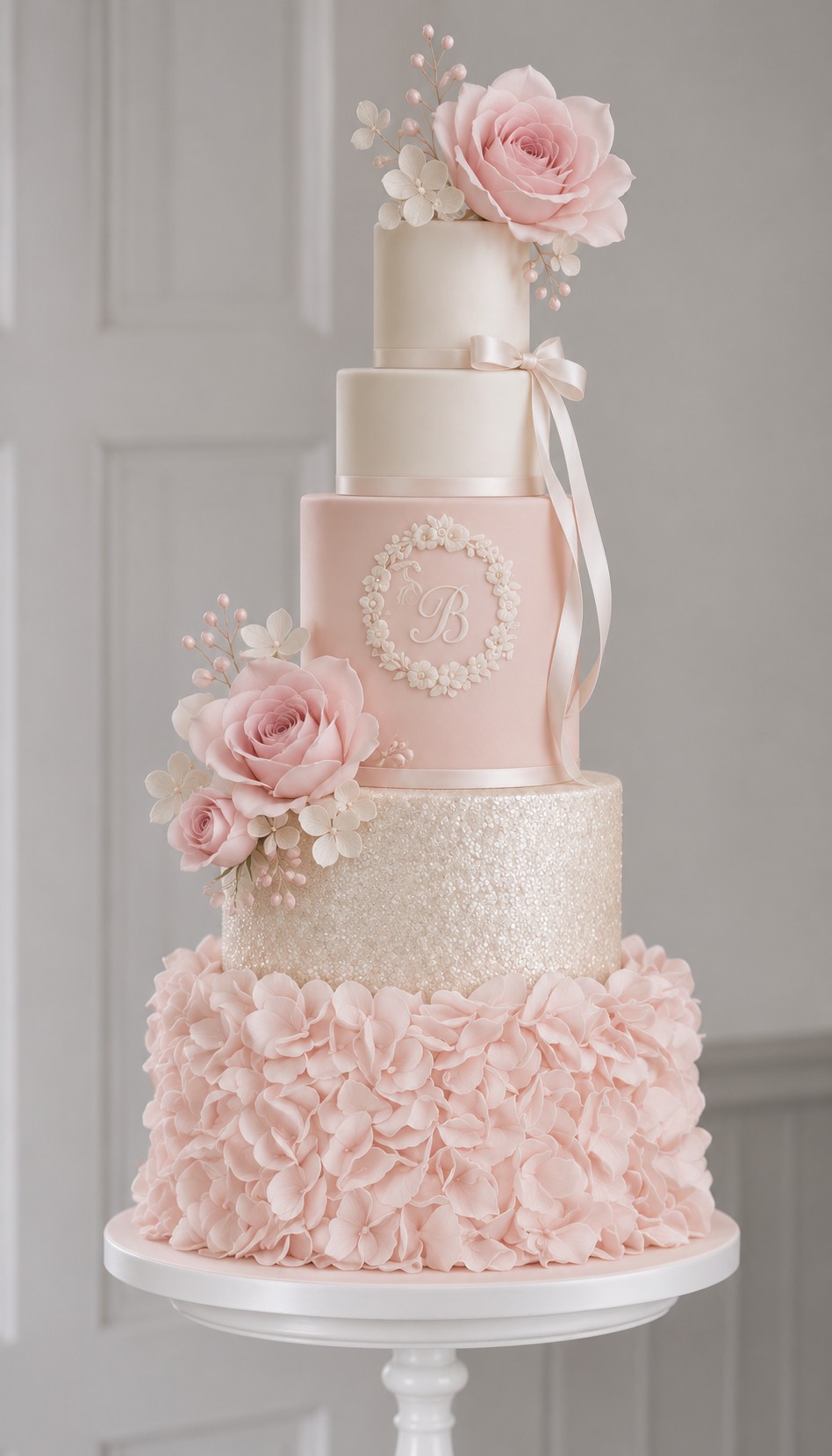
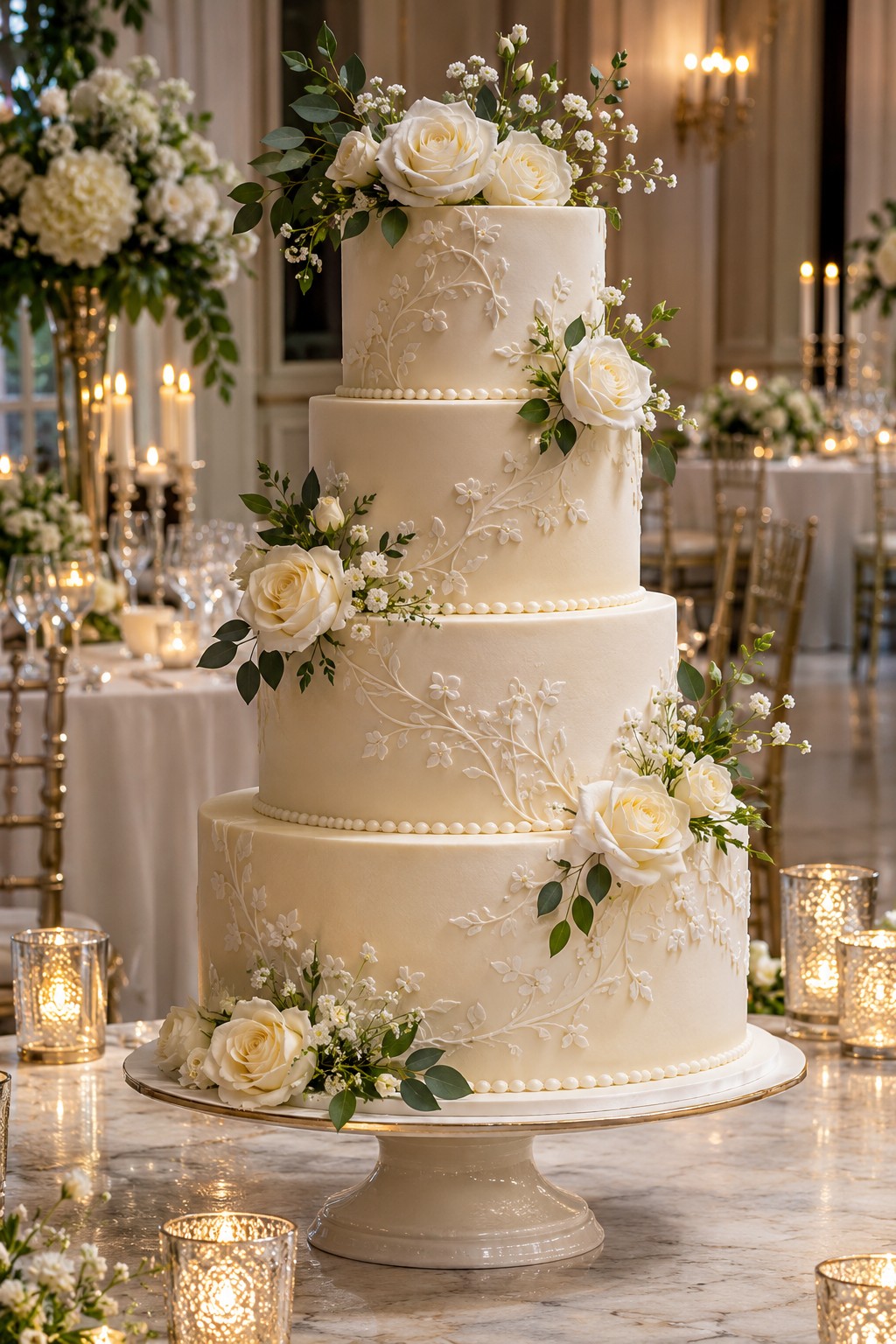
- Vintage decoration returns: ruffles, old-school piping, swans and bride-and-groom toppers are back. The petal ruffles and pearl borders in the photos above belong to this trend.
- Edible lace: fine piping that imitates lace and crochet carries the fabric of the dress onto the cake.
- Long, horizontal cakes: cakes that run along the table instead of rising upward, doubling as the centrepiece of a long table.
- Sculptural cakes: conical and abstract forms inspired by architecture and fashion.
- Square cakes: square tiers instead of round ones, or low sheet-style cakes.
- Several cakes: two or three cakes, or a full dessert table, so guests can choose among flavours.
- Classic flavours with a twist: vanilla and other familiar flavours lifted with fruit fillings, with the quality of ingredients placed ahead of novelty.
- Styling the cake table: the cake is given a prominent place, dressed with flowers reused from the ceremony.
How to choose a cake
Match the number of tiers to the size of the hall. In a large hall with a high ceiling a low cake disappears in photographs; four tiers or more, or a raised stand, suit it better. At a small or outdoor wedding a cake of one or two tiers with fresh flowers looks more natural.
Follow the colours of the dress and the flowers. The cake shares the frame with the dress, the bouquet and the flowers of the hall. Repeating the lace pattern of the dress or the flowers of the bouquet on the cake makes the photographs cohere. See How to Choose a Bouquet.
Think of the cutting cake and the serving cake separately. Many weddings prepare a decorated cake for the cutting and a separate cake to serve the guests. The larger the guest list, the more practical this is.
Outdoors and in summer, choose materials with care. Buttercream and fresh cream do not hold up in heat. At an outdoor wedding keep the cake on display only briefly, and decide on shade and an indoor waiting place in advance.
What to check when applying this in Korea
| What to check | Details |
|---|---|
| Bringing in an outside cake | Confirm before signing whether only the venue's cake may be used or a cake from an outside bakery is allowed |
| Where the cutting falls | Decide in the order of ceremony whether it belongs in the ceremony, during the meal or at the after-party |
| Whether the cake is real | Check whether any tiers are display models and whether there is enough to serve the guests |
| Storage and delivery | Fix the arrival time, the refrigerated storage, and the position and lighting of the cake table |
| Allergies and dietary needs | Check for guests who cannot eat nuts, dairy or eggs, and for halal or vegetarian guests |
| Photographs | Agree with the photographer on where the cutting will be shot and against what background |
The cake is one of the oldest parts of the wedding. From the days of kissing over a pile of buns until now the form has changed, but the meaning of sharing food has not. Whatever shape you choose, it is the first slice the two of you cut together.