
Guests first meet a wedding in the invitation, not in the hall. The moment the envelope opens, it conveys the mood and formality of the day and the taste of the couple. Overseas, the paper does not end with the invitation: everything from the card that announces the date to the menu on the table and the thank-you card afterwards is designed as one set, called wedding stationery. Here are the kinds, the timing, the wording, and what to check when you bring it to a wedding in Korea.
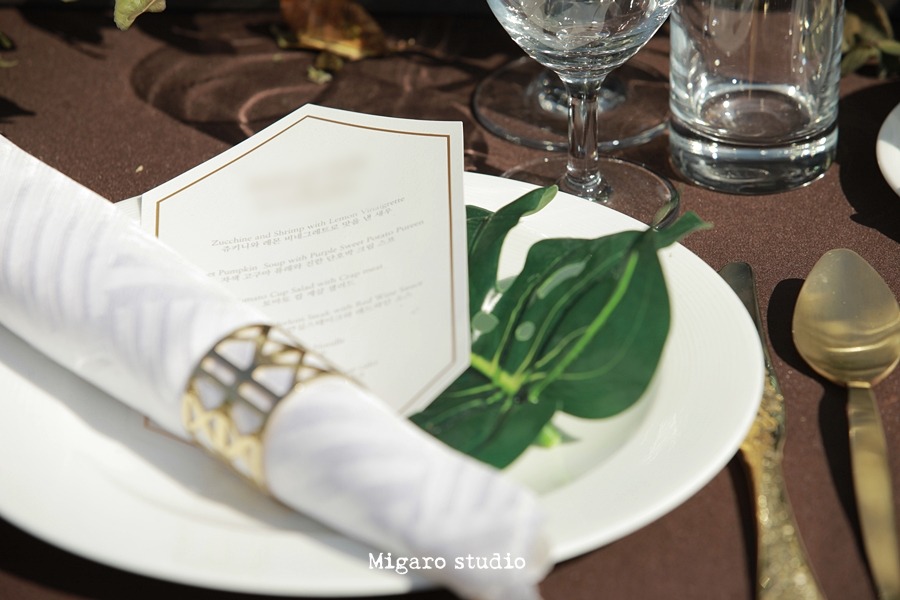
Photo: Migaro studio
What wedding stationery is
Stationery, at a wedding, means every piece of paper printed for the occasion. The Australian invitation company Paperlust divides it into four stages in its wedding stationery checklist for 2026.
| Stage | Pieces | What they do |
|---|---|---|
| Before the wedding | Save the date | Announces the date and city so guests keep it free |
| The invitation | Invitation, reply (RSVP) card, details card | The formal invitation, the reply, and directions, lodging and dress code |
| On the day | Program, menu card, table numbers, seating chart, place cards, signage | Lets guests find their seats and follow the order of the day |
| After the wedding | Thank-you card | Thanks for coming and for the good wishes |
You do not need all of them. An invitation and a word of thanks are enough to hold a wedding. But if you serve a seated meal with assigned seats, the seating chart and place cards are closer to a necessity than a decoration.
The save the date
A save the date is an advance notice. It goes out with only the date and the city, even before the venue and time are settled. It was not part of the Korean wedding, but it is very useful when guests are coming from abroad or the wedding falls on a holiday, because flights and leave have to be arranged early.
The online invitation company Greenvelope gives the following timing guide.
| Piece | Local wedding | Destination or holiday wedding |
|---|---|---|
| Save the date | 6 to 8 months before | 8 to 12 months before |
| Invitation | 6 to 8 weeks before | 10 to 12 weeks before |
| Reply deadline | 3 to 4 weeks before | 6 weeks before |
If there is no time for a save the date, skip it and send the invitation at the early end of its window.
The invitation: what to write
Five things must be on an invitation: who is inviting, whose wedding it is, the date and time, the place, and how to reply.
A Korean invitation names both sets of parents, so that the two families invite together. The traditional invitation in the English-speaking world also began with the bride's parents, but today it is common for the couple to invite in their own names. An international couple can carry both forms on one card: Korean on one side with the parents' names, English on the other with the couple inviting.
What goes in the envelope with it:
- Reply (RSVP) card: attendance, number of guests, meal choice and foods to avoid. Today a website address or QR code often takes its place.
- Details card: directions, parking and shuttle, lodging, dress code, and the schedule of events the day before.
- Envelope: writing the names precisely is how you say who is invited. If a partner or children are included, write their names too.
Set the reply deadline about a week before the caterer needs the final count. Greenvelope advises leaving at least two weeks between receipt and the deadline, and reminding those who have not replied a week before the deadline and again a day or two after it. Guest lists and replies are covered in Building the Guest List.
Paper and mobile invitations
Mobile invitations are widely used in Korea. The map, the gallery and the reply all sit on one screen. Paper has not disappeared, though: handing a printed invitation to one's elders in person is still considered proper.
Using both is the practical answer.
- Print fewer paper invitations and give them to the elders of both families and those closest to you.
- Send the mobile invitation to friends, colleagues and overseas guests.
- Keep the colours, typefaces and wording identical. Some guests will receive both.
- Make a separate English page for overseas guests, with the time zone and lodging and travel information.
Preparing for overseas guests is covered in Hosting 50 Overseas Guests.
Paper on the day: program, menu card, place card
The paper on the day lets guests move without having to ask.
The program lists the order of the ceremony, the music, and the names of the officiant or host. At a bicultural wedding, a line or two explaining an unfamiliar ritual helps both sides follow.
The menu card names the courses and sits at each place. With the couple's names or the date at the top it becomes a keepsake. If guests are coming from abroad, print it in both languages, as in the photograph above. Naming the main ingredients helps guests who cannot eat certain foods. Course planning is covered in Planning the Wedding Menu.
Three different pieces of paper guide guests to their seats.
| Piece | Where it goes | What it tells |
|---|---|---|
| Seating chart | Reception entrance | Every name with its table number |
| Escort card | A table at the entrance | One card per guest, with the table to go to |
| Place card | Each place setting | The seat within that table |
You need either the chart or escort cards, not both. Place cards are used when the seat within the table is assigned as well.
Paperlust times the day-of paper as follows. Programs, menu cards and table numbers are prepared four to six weeks before, once the order, the menu and the floor plan are confirmed. Place cards are made two to three weeks before, after the seating is final. The rule is that anything with a guest's name on it is made last.
The thank-you card
Stationery runs through to the thanks after the wedding. Paperlust advises ordering thank-you cards before the wedding and sending them within three months, ideally within two. In Korea the usual way is a text message soon after the wedding. For guests who travelled a long way or helped in a particular way, a card with a photograph from the day will be remembered.
The design trends of 2026
From the invitation trends named by the American wedding publication The Knot, these are the ones that carry over most easily.
- Handwritten typefaces and hand-drawn illustration: type that imitates real penmanship and loose line drawings, sometimes of the venue or a pet.
- Wax seals: seals that close the envelope or bind a belly band have returned.
- Bows and lace: romantic motifs such as bows, swans and lace in soft colours.
- A crest of your own: a crest made from initials or a symbol, repeated from the invitation to the menu card and signage.
- Statement day-of paper: menus, programs and escort cards made to stand out. Changing the shape, like the hexagonal menu card in the photograph, is one way.
- Design borrowed from hotels and restaurants: stripes and typefaces reminiscent of a fine restaurant's menu or a hotel's stationery.
- Conversational wording: an invitation written the way one speaks, in place of the formal set phrases.
Choosing a design
Tie it into one design. Choose two or three colours and two typefaces and use them on every piece. When the invitation, the menu card and the signage look like one set, the whole wedding looks composed.
Follow the colours of the hall and the flowers. The paper on the table shares the frame with the tableware, the napkins and the flowers. Check the colour of the linen and flowers before choosing the paper.
It must be easy to read. Keep script for headings, and set the date, time and place in a clear typeface at a generous size. If many guests are older, go one size larger.
Check names and dates twice. The spelling of names in English, the day of the week, and a.m. or p.m. are the most common mistakes. Asking someone else to read it aloud before printing is the surest check.
What to check when applying this in Korea
| What to check | Details |
|---|---|
| Timing | In Korea invitations usually go out a month or two before. For overseas guests start much earlier, with a save the date |
| The habit of replying | Korean guests are not used to replying. To settle the guaranteed number, combine the reply function of the mobile invitation with personal calls |
| Assigned seating | Many halls run open seating. Ask whether assigned seating is possible and where a seating chart can stand |
| Menu cards | Ask whether the venue makes them or you bring your own, and when the menu is confirmed |
| Two languages | Have both families confirm the English spelling of names, the English address and the time zone |
| Personal information | If a mobile invitation carries an account number or phone numbers, decide who can see it and close the page after the wedding |
The invitation is the first scene of the wedding and the thank-you card is the last. You do not need every piece of paper in between. Choose what your wedding needs, and make what you choose look like one set.