
The place where a guest spends the most time at a wedding is their own seat. Who sat beside them, whether they could see the stage, whether conversation came easily: these shape how they remember the day. Seating is the least visible part of the preparation and, at a wedding with a served meal, the one that takes the most work. Here is how to choose the shape of the tables, how many guests each seats, and how to place both families and guests from abroad. Building the list itself is covered first in Building the Guest List.
Start with the shape of the table
The first decision in seating is not a name but the shape of the table. It determines how many sit together, how conversation travels, and how many tables the hall will hold.
| Shape | Strengths | What to watch | Suits |
|---|---|---|---|
| Round | Everyone at the table sees everyone else. Easy to plan service routes and to adjust numbers | At a large table it is hard to talk across. Some seats face away from the stage | Large halls with many guests, weddings where the two sides are clearly divided |
| Long | Feels like a family meal at one table. Flowers and candelabra run its length and photograph well | Guests talk only with the three or four around them. On a narrow table, dishes and decoration compete | Small weddings, family-centred meals, halls with tall windows |
| A mix | Family and guests of honour at a long table, the rest at rounds, which gives the room a centre | Linen, chairs and flower heights must match so it reads as one room | Mid-sized weddings |
Round tables: the standard for a large hall
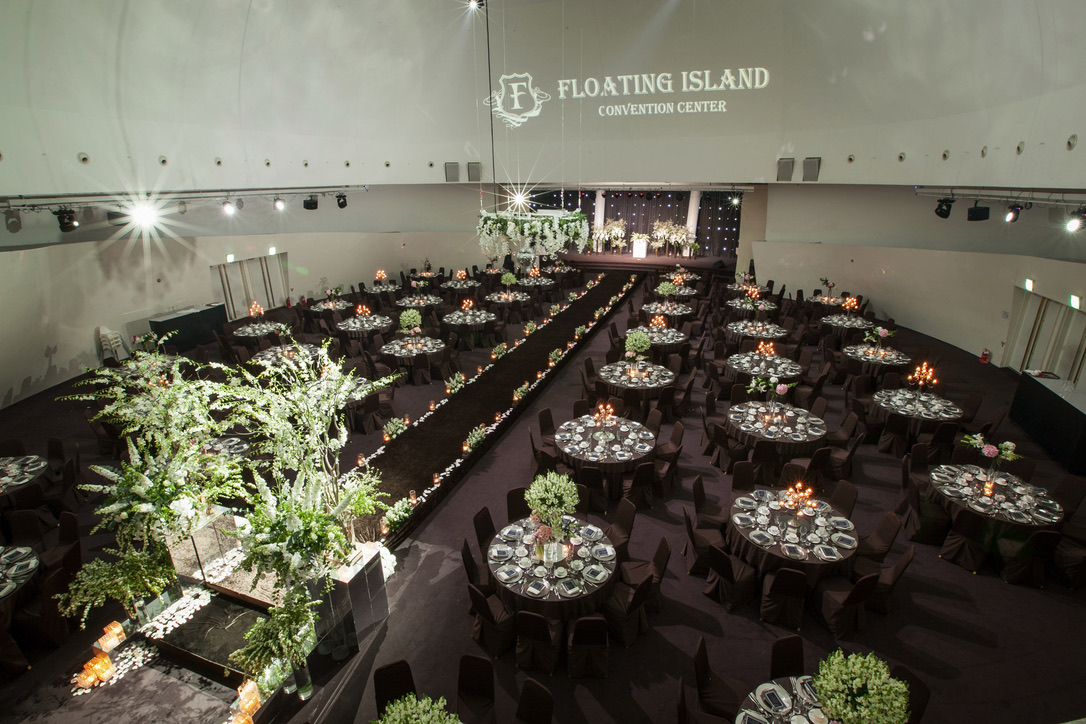
Round tables are the standard when the guest list is long. With the aisle in the centre and tables on either side, as in the photograph above, the groom's side and the bride's side divide naturally and every seat has a line of sight to the stage. Preparing for a large guest list is covered in The Case for a Convention Wedding.
The diameter of the table sets the number of guests. The Australian invitation company Paperlust gives these figures in how to make a wedding seating chart.
| Round table diameter | Comfortable | Maximum |
|---|---|---|
| About 122 cm (48 in) | 6 | 8 |
| About 152 cm (60 in) | 8 | 10 |
| About 183 cm (72 in) | 10 | 12 |
Paperlust advises planning each table at about 90 per cent of capacity, which leaves room for the one or two guests added just before the day. Korean wedding halls often use round tables for ten, so planning nine to a table leaves that margin.
At a round table some seats face away from the stage. Leaving two or three seats on the stage side empty, in a crescent, lets everyone look forward. It increases the number of tables, so weigh it against the size of the hall.
Long tables: a meal at one table
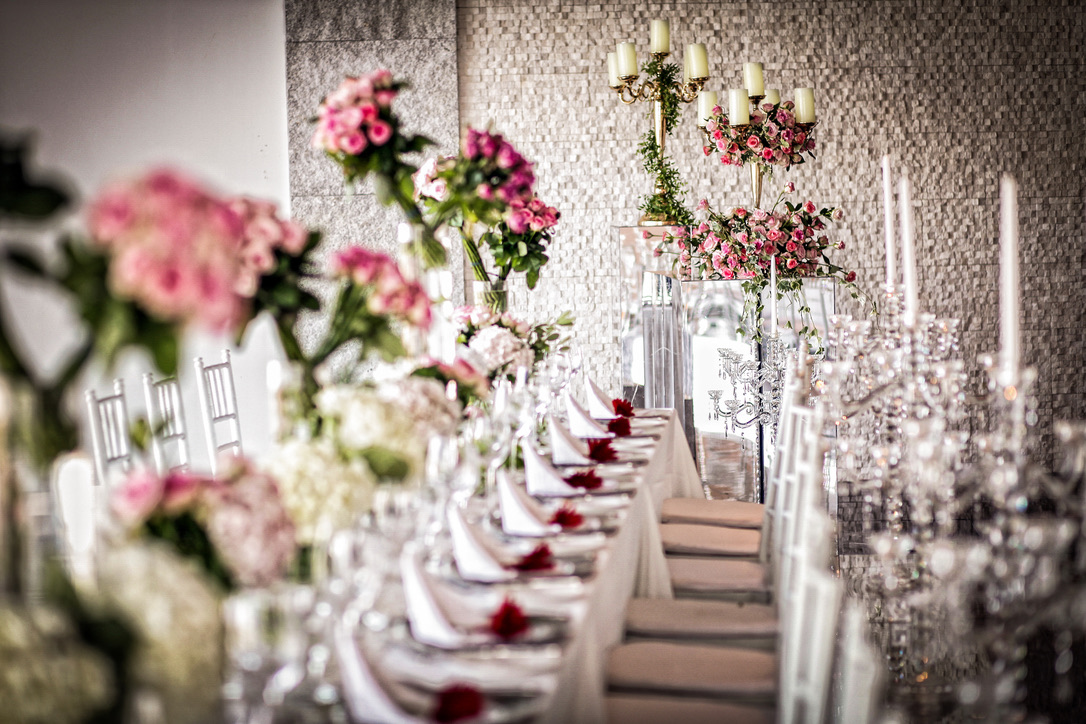
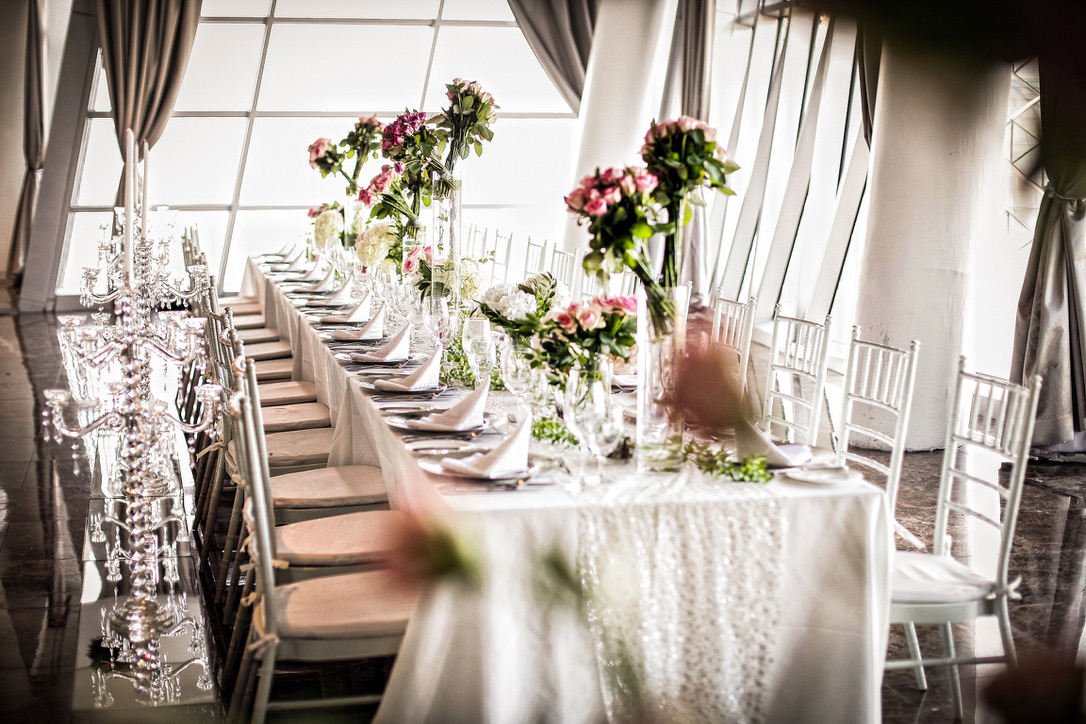
A long table seats guests as family at one table rather than as visitors. Flowers and candelabra can run its full length, which gives depth to photographs and brings out the closeness of a small wedding. The rhythm of a small wedding is covered in Micro and Small Weddings.
Paperlust's figures for long tables:
| Long table length | Comfortable | Maximum |
|---|---|---|
| About 183 cm (6 ft) | 6 to 8 | 10 |
| About 244 cm (8 ft) | 10 | 12 |
Three things to watch at a long table:
- Leave the ends empty. The American wedding publication Junebug Weddings, in its guide to the reception seating chart, advises against seating anyone at the heads of rectangular tables. Those guests fall out of the conversation and sit in the path of service.
- Control the height of the flowers. Guests must be able to see the person opposite. Keep flowers below eye level, or raise them in tall, slender vases as in the photograph above, leaving the sight line clear beneath.
- Check the width. Plates, glasses, flowers and candelabra all have to fit. On a narrow table, reduce the decoration and agree the plate sizes for the courses with the kitchen.
Where the couple sits
There are three choices.
- A sweetheart table: a small table for the two of you. No decision about who sits beside you, and every guest can see you.
- A head table: the couple with family or the wedding party, the traditional form in the English-speaking world.
- With the family: the couple at the centre of a long table with both families on either side. It suits a small wedding.
At Korean weddings the couple often spends the meal going from table to table to greet guests. Even so, it is worth setting a place where the two of you can sit and eat for a while.
Who sits where
Paperlust advises grouping guests into natural clusters and giving each table one person who will carry the conversation. On top of that:
- Close family and the wedding party: at the tables nearest the couple.
- Both sets of parents: at a Korean wedding the first tables on either side of the stage are the parents' tables. Ask both families whether they would rather share one table or sit separately with their relatives.
- Elders and guests with limited mobility: near the entrance and the restrooms, away from the speakers.
- Families with children: at the edge, where it is easy to step out. Check in advance whether a high chair is needed.
- Friends: nearer the stage and the dance floor.
- Guests coming alone: do not gather them at one table. Seat each at a table where they know at least one person.
The Knot lists among the reception seating mistakes to avoid: seating more guests than a table comfortably holds, splitting up close friends to force new acquaintances, leaving some guests stranded at tables on the edge of the room, and placing the seating chart where guests may miss it.
Overseas guests and tables in two languages
At an international wedding, language is the largest variable in seating.
- Put one person who speaks both languages at each table. Seating overseas guests together is easy but makes an island. A bilingual friend or relative at each table keeps conversation going.
- Seat those who travelled far in the middle of the room. Paperlust advises placing out-of-town guests mid-room, mixed with local friends. At the edge they are easily left out.
- Place an interpreter at the parents' table. It may be the first time the two sets of parents sit together for long. Seat a bilingual family member close by.
- Write names and menus in both languages. Place cards and menu cards are covered in Wedding Invitations and Stationery.
The timeline for the seating chart
Paperlust's schedule, counted back from the wedding day:
| When | What to do |
|---|---|
| 6 weeks before | Close replies and the guest list |
| 5 to 6 weeks before | Group guests and draft the chart |
| 4 to 5 weeks before | Show the draft to both sets of parents and hear their views |
| 3 weeks before | Fix the number of guests |
| 2 weeks before | Give the venue and kitchen the count for each table |
| 2 to 3 weeks before | Send the names for the seating chart and place cards to the printer |
Junebug Weddings' advice comes down to one line: write the seating chart in pencil. Cancellations and plus-ones change until the last week.
You can also assign tables without assigning seats. Junebug Weddings points out that guests often move even when seats are assigned. If the meal is a formal course dinner, or guests have different menus, assign seats; otherwise assigning tables is enough.
What to check when applying this in Korea
| What to check | Details |
|---|---|
| Whether assigned seating is possible | Open seating is usual in Korea. Ask whether tables can be assigned, or only the parents' and family tables |
| Table size and capacity | Ask the diameter and capacity of the hall's round tables and whether long tables can be used instead |
| Guaranteed number and table count | Tables are set to the guaranteed number. Ask whether extra tables can be added on the day |
| Sight lines to the stage and screen | Check on the floor plan or on site that no table is hidden by a column or decoration |
| Guests who do not stay for the meal | Subtract guests who only bring a gift and leave, and those who take a return gift instead of the meal |
| People to guide guests | Decide where the seating chart stands and who helps guests find their seats at the entrance |
Seating means thinking of each guest in turn: who they will be comfortable beside, what they will see and hear. When that has been worked out in advance, the welcome begins the moment a guest finds their seat.